

How Do Tight Tolerances Affect Cost, Lead Time, and Risk?
If you’ve ever ordered a precision-machined part, you’ve probably encountered the word “tolerance.” But unless you work in manufacturing every day, it’s easy to gloss over what tolerances actually mean and why they matter so much to your budget, your schedule, and the performance of your equipment.
Here’s a straightforward look at what tight tolerances really mean, and how they influence the three things customers care about most: cost, lead time, and risk.
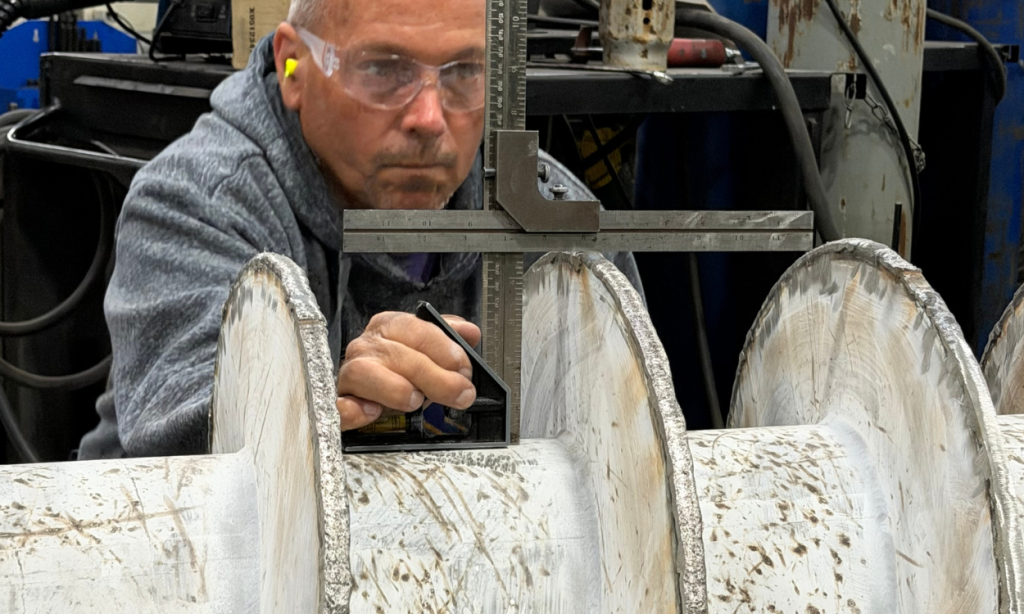
What Is a Tolerance, and When Is It “Tight”?
A tolerance is the acceptable range of variation for a dimension on a machined part. If a shaft is supposed to be exactly 4.000 inches in diameter, a tolerance of ±0.005 inches means anything between 3.995 and 4.005 inches is acceptable.
“Tight” tolerances push that range to thousandths (or even ten-thousandths) of an inch. At Carver Machine Works (CMW Global), our machinists routinely work to tolerances measured in thousandths of an inch across a wide range of materials and component sizes. That level of precision is standard practice in the aerospace, defense, naval, nuclear, and chemical processing industries we serve.
How Do Tight Tolerances Affect Cost?
The tighter the tolerance, the more it typically costs to achieve—and for good reason. Holding a part to within a few ten-thousandths of an inch requires specialized equipment, highly skilled operators, and more time at the machine.
At CMW Global, we’ve invested heavily in gold-standard equipment, including our Nomura Horizontal Boring Mill, which runs 300% straighter than Japanese Industrial Standards require. That level of machine quality is what makes tight-tolerance work reliable rather than a gamble. Add to that a team of Master Craftsmen with decades of experience, and you’re not paying for trial and error, you’re paying for certainty.
The important thing to understand: tighter tolerances aren’t always better. Specifying an unnecessarily tight tolerance for your application adds cost without adding value. Experienced shops will work with you to identify where precision is truly critical and where it isn’t.
How Do Tight Tolerances Affect Lead Time?
Tight-tolerance work takes longer but not for the reason most people assume. It’s not that the machining itself is dramatically slower. The bigger time factors are setup, fixturing, in-process inspection, and the need to get it right the first time.
When you’re working to within a few thousandths of an inch, there is no room for a “close enough” correction pass. And, when machining a part, there’s no putting material back once it’s been removed. Operators must verify dimensions at multiple stages, and any deviation means starting over. That’s why experience matters as much as equipment. Our team brings over four decades of precision manufacturing expertise to every project, which means fewer surprises and more predictable timelines.
At Carver Machine Works, we also maintain an extensive in-house equipment list, from engine lathes with up to 63” swing to vertical turret lathes with up to 79” swing, that means we rarely need to outsource operations. Keeping work in-house keeps your lead time in our control.
How Do Tight Tolerances Affect Risk?
This is where the stakes really come into focus. In industries like aerospace, naval defense, nuclear, pulp and paper, and chemical processing, a component that’s even slightly out of tolerance can cause equipment failure, safety incidents, or costly downtime. Tolerances aren’t just engineering specifications, they’re the difference between a system that works and one that doesn’t.
Managing that risk requires more than a good machine. It requires a quality system. CMW Global holds AS9100D and ISO 9001:2015 certifications, and carries NADCAP accreditation for fusion welding, one of the most rigorous third-party quality audits in manufacturing. Our NAVSEA authorization and ASME “U” and “R” stamps further validate our ability to meet demanding specifications for mission-critical work.
We also perform in-house Non-Destructive Testing (NDT) with Level 1–3 certified personnel across visual, dye penetrant, ultrasonic, radiographic, and magnetic particle methods. This means that quality verification isn’t an afterthought or an outsourced step—it’s built into every project.
The Bottom Line for Customers
When a customer brings a tight-tolerance project to Carver Machine Works, they’re not just buying machining time. They’re buying a system: the right equipment, the right people, the right certifications, and the quality controls to back it all up.
Whether you’re sourcing a new precision component, refurbishing a worn part, or working through a reverse engineering challenge, understanding how tolerances affect your project puts you in a better position to ask the right questions—and choose the right partner.
Have a tight-tolerance project? Contact the team at CMW Global to talk through your requirements.
 Skip to content