

What Should I Look for in a Precision Machine Shop?
Your project is only as reliable as the parts inside it. Whether it’s a one-off repair for a critical industrial component or a long-term defense contract, picking the wrong precision machine shop is the fastest way to blow a budget and miss a deadline. The right precision machine shop brings more than just equipment to the table. They bring experience, accountability, and the technical know-how to get the job done right the first time. Here’s what to look for.
Does the shop have real certifications, not just claims?
Certifications are a machine shop’s way of proving, through independent audits, that their processes and quality controls actually meet industry standards. Look for quality management certifications like ISO 9001:2015 and, for aerospace and defense work, AS9100D. These aren’t just plaques on a wall, they mean the shop has documented, repeatable processes and undergoes regular third-party review.
For welding specifically, NADCAP (National Aerospace and Defense Contractors Accreditation Program) certification is one of the most rigorous credentials a shop can hold, covering fusion welding on specialized materials. And if pressure vessels are involved, ASME “U” and “R” stamps indicate the shop is authorized to build or repair pressure-rated equipment to strict national codes.
CMW Global holds all of the above, ISO 9001:2015, AS9100D, NADCAP fusion welding certification, and ASME U and R stamps, along with NAVSEA authorization for naval defense work.
What equipment do they actually have on the floor?
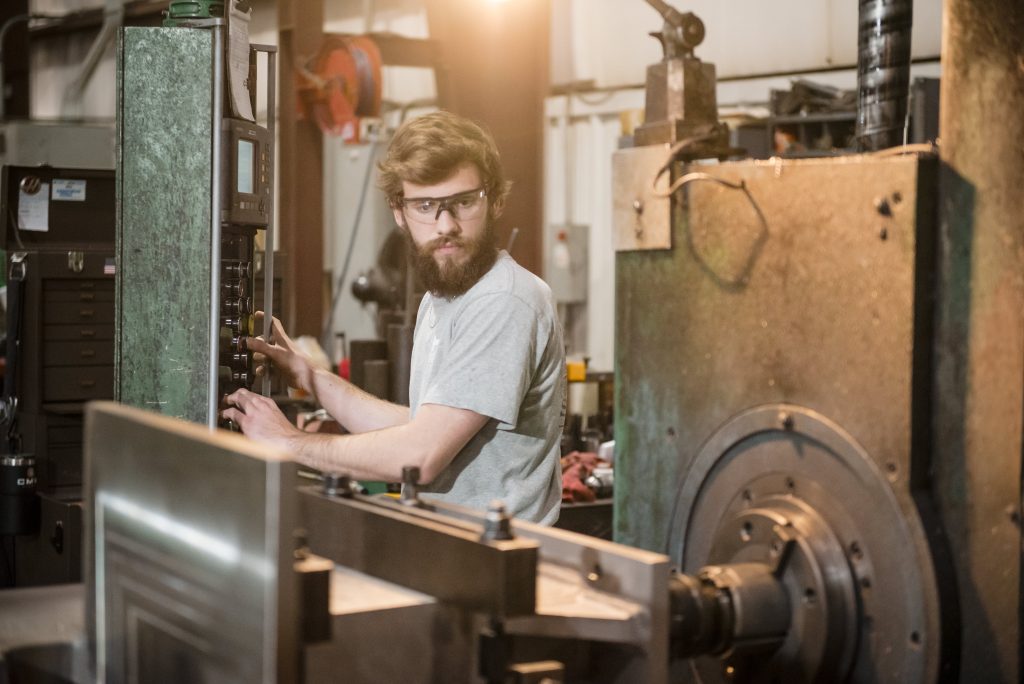
A shop’s machinery tells you a lot about what they can handle. Engine lathes, horizontal boring mills, vertical turret lathes, and CNC machining centers each have different strengths. The question isn’t just whether a shop has the right machines, it’s whether those machines are large enough and precise enough for your specific job.
CMW Global’s precision machining floor includes seven engine lathes (up to 63″ swing x 312″ overall length), three horizontal boring mills, three vertical turret lathes with up to a 79″ swing, and a HAAS CNC 3-axis milling center. For parts verification, a Faro Arm CMM (coordinate measuring machine) ensures dimensional accuracy.
Can they handle the materials your project requires?
Not every machine shop is comfortable working with exotic or high-performance alloys. If your project involves materials like titanium, Inconel, or Hastelloy, you need a shop with hands-on experience; these materials behave differently than standard steel and require specialized tooling and techniques.
CMW Global has decades of experience machining and welding a wide range of specialty materials, including titanium, Inconel, Hastelloy, and other high-nickel and high-strength alloys. That experience matters when tolerances are tight and material waste is costly.
Do they offer more than just machining?
A full-service shop can save you significant time and cost by handling multiple scopes of work under one roof. Instead of coordinating between a machinist, a welder, and a separate assembly team, look for a shop that can take your project from raw material to finished, tested component.
CMW Global offers precision machining, custom metal fabrication, welding, mechanical assembly, equipment refurbishment, balancing services, and project management, all in our 72,000-square-foot facility in Washington, North Carolina. For rotating equipment, our balancing systems handle components up to 6 feet in diameter and 5,000 pounds, using both static and dual-plane dynamic balancing.
How do they handle problems, including the ones you didn’t plan for?
Equipment doesn’t always fail on a convenient schedule. The right precision machine shop is one that responds quickly, brings genuine problem-solving experience, and doesn’t leave you guessing about timelines or costs. Ask about their approach to unplanned repairs and their track record with emergency response. At CMW global, each project is assigned to an individual sales team member who facilitates quick communication with clients. Projects are typically assigned to an individual project engineer but occasionally require a team of engineers to cover all aspects of the project. When technical issues arise, the sales representative (and occasionally the project manager) is quickly available.
CMW Global also offers reverse engineering capabilities backed by over 40 years of dimensional data for all types of industrial equipment, meaning that even if your original drawings no longer exist, we can rebuild or replicate critical components.
What industries do they serve, and does that matter?
A shop’s industry experience shapes everything from how they communicate to how they manage quality documentation. A shop that regularly works with aerospace, defense, and nuclear clients will approach quality control very differently than one that primarily handles commercial fabrication.
A shop that works within your industry knows your equipment. They aren’t just building a part, but have likely seen the entire machine and understand its critical importance in the larger workflow.
CMW Global serves clients across naval and aerospace defense, pulp and paper, nuclear, chemical processing, pharmaceutical, power generation, and heavy industrial sectors. That breadth of experience, combined with the right certifications, means we bring a high standard of quality to every project, regardless of complexity.
The Bottom Line
The best precision machine shop for your project is one that can prove their capabilities, not just describe them. Look for verifiable certifications, equipment that matches your scope, experience with your materials, and a team that treats your project as a partnership rather than a transaction. If you’d like to learn more about how CMW Global can support your next project, reach out at cmwglobal.com.
 Skip to content