
What Are the Best Practices to Effectively Manage Weld Distortion When Making Tight-Tolerance Welds?
When precision components require tolerances measured in thousandths of an inch, weld distortion control becomes the difference between meeting spec and scrapping expensive parts. Welding inherently involves intense localized heating (metal in the weld pool reaches melting temperatures on the order of 2,500–2,800 °F for steels) followed by constrained cooling. These temperature gradients create forces that can warp even well-designed, carefully prepared assemblies.
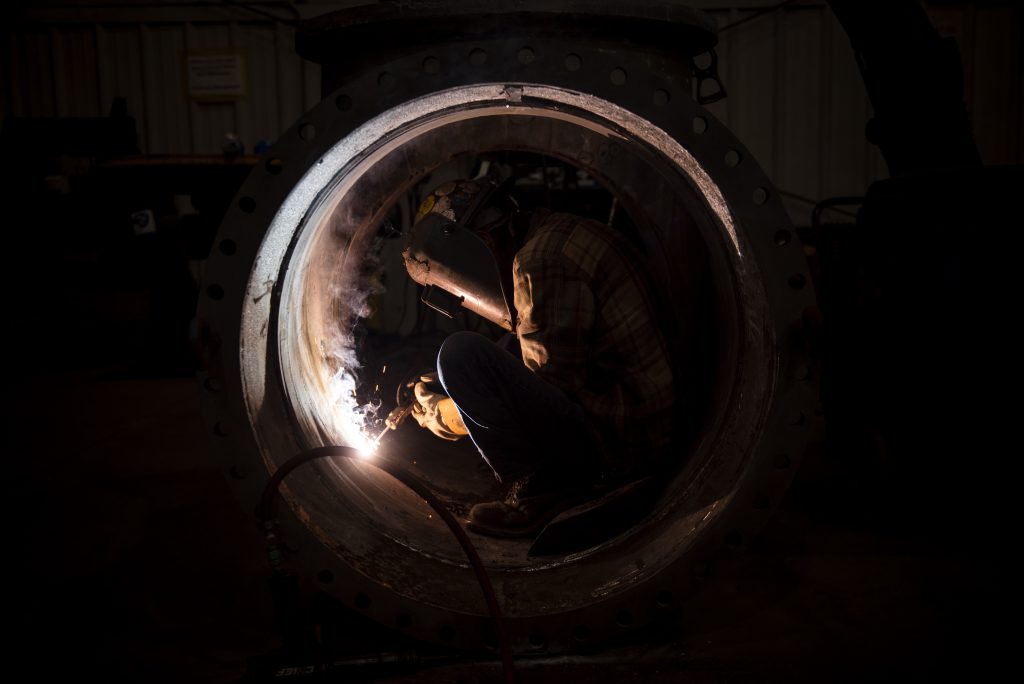
For manufacturers serving aerospace, naval defense, and high-precision industrial markets, distortion management must be an integrated competency: understanding root causes, designing for stability, applying optimized welding practices, and planning corrective machining when required.
With more than four decades of specialized experience, Carver Machine Works (CMW Global) is one of the region’s longest-standing NADCAP-certified fusion-welding facilities and a trusted supplier for aerospace, defense, and nuclear applications, making us an expert in this topic.
What Causes Weld Distortion in Precision Fabrications?
Distortion originates from basic thermal mechanics. When metal heats and expands in the weld zone while the surrounding material remains cool, compressive stresses form. As the weld cools and contracts, the surrounding structure resists this movement, producing tensile stresses. If these stresses exceed the material’s yield strength, permanent deformation results.
Several factors influence the magnitude of distortion:
- Coefficient of thermal expansion: Austenitic stainless steels distort more readily than carbon steels because they expand more and conduct heat less efficiently.
- Thickness: Thin sections have limited mass to absorb heat and are especially prone to warping.
- Joint type and weld size: Larger welds create larger heat-affected zones and higher contraction forces.
Common distortion modes include transverse shrinkage, longitudinal bowing, and angular distortion, especially in single-sided welds where contraction is unbalanced.
How Can Fixture Design Minimize Weld Distortion?
A well-engineered fixture is often the most powerful tool for distortion control. Fixtures counteract thermal forces, maintain geometry during the weld cycle, and help manage heat flow.
Key principles include:
Mechanical Restraint
Clamping the assembly in its nominal final shape forces much of the shrinkage to be absorbed as residual stress rather than part movement. Residual stresses often approach a significant fraction of the base material’s yield strength, so proper restraint is essential.
Accurate Locating
Locators should reference machined surfaces, not formed edges. Uneven or inconsistent reference points invite misalignment that fixtures cannot correct.
Appropriate Clamping Pressure
Clamps must apply enough force to prevent slipping but not so much that they deform thin walls. For robotic welding, a common guideline is to position joints within roughly half the filler wire diameter in the critical axis (e.g., ~0.020″ for 0.045″ wire), depending on robot capability and joint design.
Thermal Management
Fixtures may incorporate heat sinks, such as water-cooled backing bars or heavy strongbacks, to reduce thermal gradients. Some advanced fixtures use sliding or spring-loaded elements that maintain consistent pressure while accommodating controlled expansion during welding.
What Welding Sequence Strategies Reduce Distortion?
Strategic sequencing can significantly reduce cumulative distortion, often achieving improvements in the tens of percent compared to ad-hoc welding patterns.
Backstep Welding
Rather than progressing continuously in one direction, backstep welding divides the joint into short segments welded opposite the overall travel direction. Each new segment partially offsets previous shrinkage.
Balanced Welding
For multi-pass or double-sided welds, alternating sides keeps contraction forces in equilibrium. For example, in double-V grooves, depositing a few passes on one side and then switching to the opposite prevents severe angular pull.
Block Sequencing
For large assemblies, welding non-adjacent segments first limits localized heat buildup. Once the structure stabilizes, remaining gaps are filled.
Framework-First Approach
Beginning with welds that create a rigid skeleton, then adding secondary connections, often yields better dimensional control than completing isolated subassemblies sequentially.
How Do Welding Parameters Influence Distortion?
Welding parameters govern the thermal energy introduced into the part:
- Heat input, calculated from voltage, amperage, and travel speed, directly affects distortion. Minimizing heat input while maintaining sound fusion is fundamental.
- Travel speed is especially influential: slower speed increases heat input dramatically, expanding the heat-affected zone and increasing contraction forces.
- Process choice matters:
- GTAW/TIG offers concentrated heat and excellent control, ideal for thin or tight-tolerance work.
- GMAW/MIG provides higher deposition with moderate heat input and good productivity.
- Arc length should be kept as short as practical to concentrate heat in the joint.
- Pulsed welding alternates high-current and low-current phases, reducing average heat input and improving bead control which is helpful for managing distortion in thin or heat-sensitive materials.
When Is Post-Weld Machining Necessary?
For applications requiring tolerances tighter than roughly ±0.010″, post-weld machining is often essential. The goal is not to eliminate distortion entirely but to manage it and then restore precision through machining.
In aerospace and advanced industrial components (where tolerances of ±0.005″ or tighter are common) designers often:
- Add machining stock to critical surfaces.
- Machine datum features before welding and finish-machine after welding and stress relief.
- Use machining allowances between 0.030″ and 0.125″, depending on geometry and weld size.
Post-Weld Heat Treatment (PWHT)
For many carbon steels, PWHT cycles in the ~1,100–1,200 °F range with hold times specified by code help reduce residual stresses and stabilize the structure before final machining. The degree of stress relief depends on material grade and cycle parameters, so exact stress-reduction percentages should come from applicable specifications or test data.
CMW Global’s Experience with Tight-Tolerance Aerospace Components
As mentioned above, Carver Machine Works (CMW Global) is one of the region’s longest-standing NADCAP-certified fusion-welding facilities and a trusted supplier for aerospace, defense, and nuclear applications.
CMW’s precision welding capability is built on:
- NADCAP accreditation in fusion welding
- AS9100 and ISO 9001 certifications
- Validated welding procedures and documented process control
- In-house NDT capabilities (VT and PT Levels 1–2, with Level 3 access for VT, PT, UT, RT, and MT)
The company’s deep experience in high-precision weld repairs, particularly on industrial pump components, has driven the development of advanced practices for minimizing distortion, managing heat input, and restoring dimensional accuracy. These methods support component reuse and reduce overall lifecycle cost compared to full replacement.
Conclusion: Balancing Prevention and Correction
No single technique eliminates weld distortion. The most reliable results come from combining:
- Strong understanding of thermal mechanics
- Robust fixturing and heat-management strategies
- Optimized sequencing and welding parameters
- Planned corrective machining when tolerances demand it
For mission-critical applications, success depends not just on welding skill but on systematic distortion control throughout the entire manufacturing process. Fabricators with NADCAP accreditation, validated procedures, comprehensive NDT, and precision machining capability, such as CMW Global, consistently deliver the dimensional accuracy required for high-performance components.
 Skip to content